Physical Address
304 North Cardinal St.
Dorchester Center, MA 02124
Physical Address
304 North Cardinal St.
Dorchester Center, MA 02124

GRC (Governance, Risk, and Compliance) roles are among the most in-demand positions in Saudi Arabia and the GCC, driven by NCA ECC mandates, SAMA regulatory requirements, and growing organisational investment in cybersecurity frameworks. Whether you are applying for a GRC analyst, GRC consultant, or GRC specialist role, this guide covers the questions you are most likely to face — with detailed model answers you can adapt to your experience.
GRC stands for Governance, Risk, and Compliance. Governance refers to the framework of policies, structures, and processes by which an organisation directs and controls its IT and security activities. Risk management involves identifying, assessing, and treating risks to the organisation’s information assets and operations. Compliance involves ensuring that the organisation meets its obligations under applicable laws, regulations, and standards.
A GRC function brings these three disciplines together into a coherent programme. Rather than managing governance, risk, and compliance in silos, an integrated GRC approach ensures that risk assessments inform compliance activities, that compliance obligations are reflected in governance policies, and that governance structures provide oversight of the whole programme. In practice, a GRC specialist may work across risk registers, policy management, control testing, regulatory submissions, and internal audit support.
The core frameworks a GRC specialist should know include: COBIT 2019 for IT governance; ISO/IEC 27001 for information security management systems; NIST CSF (Cybersecurity Framework) for cybersecurity risk management; ISO 31000 for enterprise risk management; and, for organisations operating in Saudi Arabia, the NCA Essential Cybersecurity Controls (ECC) and the SAMA Cybersecurity Framework.
When answering, match the frameworks to the employer’s sector. A candidate for a Saudi bank role should lead with SAMA and NCA ECC. A candidate for a multinational should emphasise ISO 27001 and NIST CSF. For a government or critical infrastructure role, NCA ECC is mandatory knowledge. Demonstrating familiarity with the Saudi regulatory landscape specifically — not just generic international frameworks — signals genuine market readiness.
A risk is the possibility that an event or condition will occur and negatively affect the achievement of objectives. It is typically expressed in terms of likelihood and impact. A control is a measure — technical, procedural, or administrative — implemented to reduce the likelihood or impact of a risk. Controls are responses to risks; risks are what controls are designed to manage.
A practical example: the risk is that a former employee retains system access after termination and exfiltrates data. The controls that address this risk include: a leaver process that triggers automated access revocation within 24 hours of termination, a quarterly user access review, and monitoring alerts for off-hours logins. Each control reduces either the likelihood or the impact of the risk materialising.
A risk register is the central document that records identified risks, their likelihood and impact ratings, the controls in place, the residual risk after controls, the risk owner, and the treatment plan. Building one starts with a risk identification exercise — typically through workshops with business owners, review of past incidents, and benchmarking against industry threat intelligence.
Each risk is rated using a likelihood-impact matrix (commonly 5×5), giving an inherent risk score before controls and a residual risk score after controls are applied. The register should be reviewed at least quarterly and updated whenever a significant change occurs — a new system deployment, a regulatory change, or a security incident. The register is not a static document: its value comes from active maintenance and regular escalation of high-residual risks to the risk committee or CISO.
An NCA ECC gap assessment follows a structured process. First, scope the assessment — identify which systems, services, and organisational units are in scope based on the entity’s criticality classification. Second, map the organisation’s existing controls to the ECC control domains (Cybersecurity Governance, Cybersecurity Resilience, Third-Party Cybersecurity, Cloud Cybersecurity, Industrial Control Systems Cybersecurity, and Compliance). Third, for each control, assess the current maturity level against the ECC’s five-level maturity model — from Level 1 (initial/ad hoc) to Level 5 (optimising).
Fourth, document the gaps — the difference between the required maturity level and the current level for each control. Fifth, prioritise gaps by risk impact and regulatory obligation, and develop a remediation roadmap with owners, timelines, and resource requirements. Finally, produce the assessment report in the format required for NCA submission. Common high-risk gaps found in practice include: absence of a formal cybersecurity strategy, lack of third-party cybersecurity assessments, and immature incident response capabilities.
Good policy management starts with a clear policy hierarchy: a top-level Information Security Policy approved by the board or equivalent, supported by topic-specific policies (Access Control Policy, Incident Response Policy, Acceptable Use Policy, etc.), and implemented through procedures and standards at the operational level. Each policy should have a defined owner, review cycle (typically annual), and version history.
When developing a new policy, start by identifying the regulatory or business requirement it addresses, then draft in plain language — policies that cannot be understood by the people they govern are not effective. Circulate for review to relevant stakeholders (IT, legal, HR, risk), obtain formal approval from the appropriate authority, and ensure all staff have completed read-and-acknowledge. Track compliance with policies as part of the GRC programme’s key metrics. A common weakness is having well-written policies that are never reviewed after initial approval — staleness is itself a compliance risk.
A control self-assessment is a technique in which business units or process owners evaluate the effectiveness of their own internal controls, rather than having an independent function do so. CSAs are typically structured as questionnaires or facilitated workshops, and the results are reviewed and validated by the GRC or internal audit function.
CSAs are most useful when the GRC team has limited capacity to perform full control testing across all units, when you want to build risk ownership culture within the business, or as a first-pass screening to identify where deeper independent testing is needed. The limitation is that CSAs rely on the business’s own assessment — they can be subject to optimism bias or deliberate misrepresentation. Results should always be calibrated against independent evidence samples before final conclusions are drawn.
Third-party risk management (TPRM) involves assessing and monitoring the cybersecurity and compliance posture of vendors, suppliers, and service providers that have access to the organisation’s data or systems. The process typically starts at onboarding: classify the vendor by risk tier based on the data they access and their level of connectivity. High-risk vendors (e.g., cloud providers with access to sensitive data) receive full due diligence — security questionnaire, review of certifications (ISO 27001, SOC 2), and contractual clauses covering data protection and right to audit.
Ongoing monitoring should include annual re-assessment for high-risk vendors, contract clause enforcement, and incident notification obligations. Under NCA ECC Domain 3 (Third-Party Cybersecurity), organisations must have a formal third-party cybersecurity policy and assess vendors against it. A common failure mode is robust onboarding with no ongoing monitoring — a vendor’s security posture can deteriorate significantly after they have been approved.
The first step is to obtain and read the regulation carefully — regulatory language is precise, and misreading obligations is a significant risk. Map the obligations to your existing control framework: which requirements are already met, which are partially met, and which represent genuine gaps. Engage legal counsel for any ambiguous provisions. Then produce a regulatory impact assessment — a document that summarises the obligations, their effective date, the gaps, and the estimated effort to remediate.
Present the impact assessment to senior management and the relevant risk committee, with clear timelines and resource requirements. Assign control owners to each gap and track remediation against the regulatory deadline. Update your policy framework and training programme to reflect the new requirements. For Saudi organisations, this process is particularly important for NCA and SAMA updates, which can have short implementation timelines and mandatory attestation requirements.
Silent control failure — where a control appears to be operating but is not — is one of the most serious findings in GRC. The first action is to assess the risk exposure: what is the worst-case impact of three months of this control being ineffective? If the control relates to access management, incident detection, or data protection, this may require immediate escalation to the CISO and potentially the board.
Document the finding in full — when the failure started (or the earliest evidence of it), the root cause, and the exposure window. Implement immediate compensating controls to mitigate ongoing risk while the primary control is restored. Then conduct a root cause analysis: was this a process failure, a technology failure, or a people failure? Update your control monitoring framework to detect this type of failure in future. If the failure has regulatory implications (e.g., a SAMA or NCA reporting obligation was missed), engage legal and compliance immediately to assess notification requirements.
Executives make decisions based on business impact — they are not interested in technical vulnerability details but they are very interested in financial exposure, regulatory penalties, reputational damage, and operational disruption. Translate every risk into these terms. Instead of “our vulnerability scanning shows 47 critical CVEs on perimeter systems,” say “our perimeter systems have 47 unpatched critical vulnerabilities that could allow an attacker to take control of our core banking platform, resulting in potential regulatory penalties under SAMA and service outages affecting all retail customers.”
Use a risk heat map or dashboard — visual tools make risk posture immediately legible to senior audiences. Prepare a one-page executive summary for each board or committee presentation, with the top five risks by residual rating, the trend (improving, stable, or deteriorating), and the key decisions or approvals required from the board. Always include the “so what” — executives should leave every risk presentation knowing what they need to decide or approve.
The NCA ECC is structured around five main domains. Cybersecurity Governance covers strategy, policy, roles, and awareness — the organisational foundation. Cybersecurity Defence covers identity and access management, asset management, vulnerability management, change management, and security operations. Cybersecurity Resilience covers business continuity, backup and recovery, and disaster recovery. Third-Party Cybersecurity covers supplier risk management and cloud security. Industrial Control Systems Cybersecurity applies specifically to OT/ICS environments.
Organisations are assessed against each control on a maturity scale, and must reach the minimum required maturity level (which varies by control criticality). The ECC also has a companion framework — the Cloud Cybersecurity Controls (CCC) — for organisations using cloud services. NCA assessments are submitted annually, and results are reported directly to the National Cybersecurity Authority. A GRC consultant in Saudi Arabia should be able to map these domains to ISO 27001 Annex A controls, as many organisations use both frameworks simultaneously.
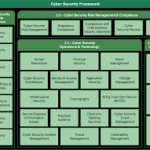
SAMA’s Cybersecurity Framework applies to all financial institutions regulated by the Saudi Central Bank — banks, insurance companies, and financial market infrastructure. It is structured around four cybersecurity domains: Leadership and Governance, Risk Management and Compliance, Operations and Technology, and Third-Party Management. Like NCA ECC, it uses a maturity model for self-assessment.
Key requirements include: appointment of a Chief Information Security Officer (CISO), a board-approved cybersecurity strategy, annual cybersecurity risk assessments, mandatory incident reporting to SAMA within defined timeframes, and assessment of all critical third-party providers. SAMA also requires that sensitive financial data is stored within Saudi Arabia (data localisation). A GRC consultant working in financial services must be fluent in SAMA requirements and able to map them to the organisation’s existing controls to identify compliance gaps.
The Saudi Personal Data Protection Law (PDPPL) imposes obligations on any organisation that collects, processes, or stores personal data of Saudi residents. For a GRC programme, PDPPL introduces several new control requirements: a legal basis must exist for each category of data processing; data subjects must be able to exercise their rights (access, correction, deletion); personal data must not be transferred outside Saudi Arabia without meeting the regulatory requirements for cross-border transfers; and data breaches must be reported to SDAIA and affected data subjects within defined timeframes.
Practically, PDPPL integration into a GRC programme involves: conducting a data inventory to identify what personal data is held and under what legal basis; updating privacy notices and consent mechanisms; implementing a data subject rights request process; and adding data breach notification procedures to the incident response plan. PDPPL compliance is increasingly being assessed as part of NCA ECC Domain 1 (Governance), as regulators expect organisations to have a coherent data protection posture.
GRC is one of the few functions that needs cooperation from almost every part of the organisation, yet rarely has direct authority over those it depends on. Buy-in is built through three things: relevance (making GRC activities relevant to what each stakeholder cares about), simplicity (making compliance as easy as possible — complex processes get bypassed), and visibility (keeping leadership informed so they champion the programme from above).
Practically: involve business stakeholders early in risk assessments and policy development rather than presenting them with completed documents. Frame control requirements in terms of the business risk they prevent — not as compliance overhead. Build relationships with IT, HR, legal, and operations counterparts so that when you need evidence or action, you have channels that work. For Saudi organisations where leadership alignment is particularly important, ensure the CISO and at least one C-suite sponsor are actively engaged and visibly supporting the GRC programme.
Common GRC platforms include ServiceNow GRC, RSA Archer, MetricStream, OneTrust (particularly strong for privacy and PDPPL use cases), and LogicGate. For smaller organisations or early-stage GRC programmes, structured spreadsheets and SharePoint-based workflows are common, though they do not scale well. The choice of tool should be driven by the organisation’s maturity, the frameworks it must comply with, and its integration requirements (e.g., integration with SIEM, ticketing, and HR systems for automated risk data feeds).
When evaluating tools, the key criteria are: whether the tool natively supports the frameworks in scope (NCA ECC, SAMA, ISO 27001), the ease of reporting for regulatory submissions, the workflow capabilities for evidence collection and control testing, and the total cost of ownership including implementation and ongoing maintenance. Be cautious about over-engineering: a GRC tool that the team cannot operate effectively is worse than a well-maintained spreadsheet. Build tool sophistication in line with programme maturity.
If you are building or scaling a GRC programme for NCA ECC, SAMA, or PDPPL compliance, a purpose-built platform can significantly reduce the time spent on evidence collection and regulatory reporting. GRCVantage is designed for Saudi and GCC organisations managing exactly these obligations.